
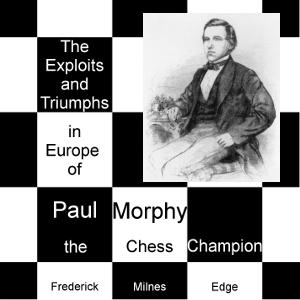
The Exploits and Triumphs, in Europe, of Paul Morphy, the Chess Champion
Paul Morphy, born in New Orleans in 1837, was considered the greatest chess player of his era. He was a child prodigy who learned playing chess simply by watching family members play, and when he was only 9 years old, he was hailed as the best chess player in New Orleans. This book describes Morphy’s trip to Europe, i.e., England and France, where he wanted to play the European Champion Staunton, a match that never came about as the correspondence included in this book shows. He did play – and beat – virtually every other strong player in Europe though, and tales of these matches and people make up a large part of this book. After his triumphs in Europe, Paul Morphy was considered the unofficial World Chess Champion, as official championship tournaments were only held from 1886. Morphy retired from chess in 1859 in order to devote himself to his law practice. He died from a stroke in 1884. (Summary by Availle)
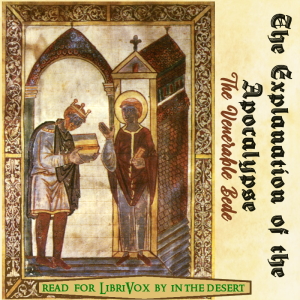
The Explanation of the Apocalypse
The Explanation of the Apocalypse by Ven. Beda is the earliest of the many works of our own writers on that Book, and, as such, may well deserve to appear in a form accessible to English readers. The chief characteristics of Beda’s method of exposition may be thus stated. The several visions are considered not to be successive, but contemporaneous, with occasional recapitulations and to represent the condition of the Church in all ages, under different aspects. The thousand years, in the twentieth chapter, are interpreted of the present period of the Church’s existence, in accordance with the opinion of St Augustine, in the second part of his De Civitate Dei. The ‘attention is closely directed to the text, and to corresponding passages of Holy Scripture, that the meaning of the symbolic language may be elicited. The previous exposition of Tichonius is mainly, but not exclusively followed. Beda appears, for example, to have adopted several opinions from St. Gregory the Great, and Frimasius, as well as St. Augustine. The date of the “Explanation” is circa. A.D. 710 ? 716. It is described by Beda as an “Exposition” but it is called an “Explanation” in the printed editions of his works. (Preface)
Explanation of Catholic Morals
A Concise, Reasoned, and Popular Exposition of Catholic Morals. The ten commandments, vice and virtue from the Catholic perspective. The contents of this volume appeared originally in The Catholic Transcript, of Hartford, Connecticut, in weekly installments, from February, 1901, to February, 1903.
The Explanation
LibriVox volunteers bring you 16 recordings of The Explanation by Rudyard Kipling. This was the Weekly Poetry project for November 1st, 2009.

Short Story Collection Vol. 084
And so we present the 84th Librivox Short Story Collection! Each tale is selected and read by a Librivox volunteer. Once again, we have a wide variety of stories, from the amusing to the perplexing. Zane Grey, Maxim Gorky and H.G. Wells are among the authors selected this time round.
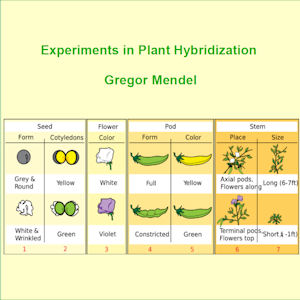
Experiments in Plant Hybridisation
Gregor Mendel was an Augustinian monk in the St. Thomas monastery in Brno. His seminal paper “Experiments in Plant Hybridization” presents his results of studying genetic traits in pea plants. It is the ground breaking work on inheritance, being the first to differentiate between dominant and recessive genetic traits. His work was long ignored and deemed controversial, however, at its rediscovery at the turn to the 20th century, it earned Gregor Mendel the title “father of modern genetics”. (Summary by Availle)

Experiments and Observations on Different Kinds of Air
Joseph Priestley, FRS was an 18th-century English theologian, Dissenting clergyman, natural philosopher, chemist, educator, and political theorist who published over 150 works. In ?Experiments and Observations on Different Kinds of Air,? he reviews experiments with gases. A common theme in this work is measuring the volumes of gases held in glass tubes, and their increase or decrease when exposed to other substances. He also tests the effects of gases on mice, plants and insects. Priestley demonstrated that fixed air (now known as CO2) can be produced from several reactions including alcoholic fermentation, combustion and a mixture of oil of vitriol and chalk (sulfuric acid and calcium oxide). He also showed that it is soluble in water, and that its toxic effects can be reduced when agitated in water. In other experiments, he showed that combinations of gases can mix to form a smaller volume than the sum of both separate gases, as when he combined common air (atmospheric air) with nitrous air (nitric oxide, NO). For some experiments, Priestley tests whether the properties of gases change when stored. He finds that inflammable air (hydrogen, H2 or a mixture of hydrocarbons) becomes less flammable but retains its toxic properties. Also interested in electricity, Priestley tests the effects of gases on sparks. While he finds that gases are generally good insulators, he also finds that some gases change the colors of electric sparks. He also discovers that some mixtures of air explode in their entirety, while others must be combined with common air in order to burn. Priestley uses several terms common to the study of natural philosophy, or chemical experiments as known today. Some of the terms are parts of obsolete theories or are old names for chemicals now given standard names. To better understand Priestley’s observations, the following terms are defined according to their present names. here
The Experienced English Housekeeper
‘Cut a large old hare in small pieces, and put it in a mug with three blades of mace, a little salt, two large onions, one red herring, six morels, half a pint of red wine, three quarts of water, bake it in a quick oven three hours…’. English cooking at its best from eighteenth-century celebrity chef, Elizabeth Raffald. Born in Doncaster, Raffald worked for 15 years as housekeeper in great houses, including that of Lady Elisabeth Warburton at Arley Hall, Cheshire, before setting up as a confectioner and innkeeper in Manchester. The Experienced English Housekeeper was published in 1769 and ran to 13 editions. This reading is from the 10th edition (1786) and includes 900 recipes (or as listeners will discover, receipts). Vegetarians take note, some sections of this book contain large quantities of meat! (Summary by Phil Benson)

The Expedition of the Donner Party and its Tragic Fate
The Donner Party was a group of California-bound American settlers caught up in the “westering fever” of the 1840s. After becoming snowbound in the Sierra Nevada in the winter of 1846?1847, some of the emigrants resorted to cannibalism. Although this aspect of the tragedy has become synonymous with the Donner Party in the popular imagination, it actually was a minor part of the episode. The author was about 4 at the time. The first part of the book accounts the tragic journey and rescue attempts; the last half are reminiscences of the child orphan, passed from family to family while growing up. (Summary from Wikipedia & Tricia G)
The Expedition of Humphry Clinker
The Expedition of Humphry Clinker was the last of the picaresque novels of Tobias Smollett, and is considered by many to be his best and funniest work. Published in London on 17 June 1771, it is an epistolary novel, presented in the form of letters written by six different characters: Matthew Bramble, a Welsh Squire; his sister Tabitha; their niece and nephew, Jery and Lydia Melford; Tabitha’s maid Winifred Jenkins; and Lydia’s suitor, Wilson. Much of the comedy arises from differences in the descriptions of the same events by different participants. Attributions of motives and descriptions of behavior show wild variation and reveal much about the character of the teller. The setting, amidst the high-society spa towns and seaside resorts of the 18th century provides his characters with many opportunities for satirical observations on English life and manners. (Summary by Wikipedia)

Exotics and Retrospectives
Lafcadio Hearn, born 1850 in Greece, went to Japan when he was 40 years old and became a Japanese citizen only 6 years later. His writings about Japan from the beginning of the Meiji era, when the country was just opening to the West, remain among the most important explanations of Japanese culture. This book contains in the first part, “Exotics”, his observations of and personal insights into Japan. For example, Fuji no Yama tells about him climbing the highest mountain in Japan; and A Question in the Zen Texts, Literature of the Dead, and Of Moon Desire try to explain Buddhist teachings. In the second part, “Retrospectives”, Hearn leaves both Japan and his vantage point as impartial observer behind and delves into personal experiences and musings that occurred to him in the numerous countries he visited. The main topic of these very personal pieces is beauty in all its forms. (Summary by Availle)
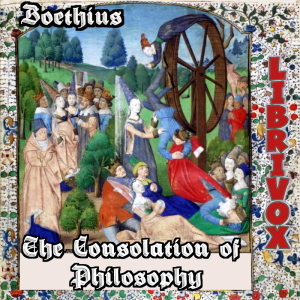
The Consolation of Philosophy (Version 2)
The Consolation of Philosophy was written about 524 A.D. and has been called one of the most popular and influential books ever written. The book is presented as a dialogue between Boethius, the author, and Lady Philosophy, his tutor. Through her teaching, Boethius learns the true nature of fortune, misfortune, wealth, good, and evil. This dramatic reading is an attempt to present this wonderful work in an audio format while maintaining the dialogic structure of the work. (Devorah Allen) Cast List Boethius, the Narrator: Larry Wilson Philosophy: Devorah Allen Headings and Footnotes: KevinS
The Consolation of Philosophy
Consolation of Philosophy (Latin: Consolatio Philosophiae) is a philosophical work by Boethius written in about the year 524 AD. It has been described as the single most important and influential work in the West in medieval and early Renaissance Christianity, and is also the last great work that can be called Classical. Consolation of Philosophy was written during Boethius’ one year imprisonment while awaiting trial, and eventual horrific execution, for the crime of treason by Ostrogothic King Theodoric the Great. Boethius was at the very heights of power in Rome and was brought down by treachery. It was from this experience he was inspired to write a philosophical book from prison reflecting on how a lord’s favor could change so quickly and why friends would turn against him. It has been described as ?by far the most interesting example of prison literature the world has ever seen.? The Consolation of Philosophy stands, by its note of fatalism and its affinities with the Christian doctrine of humility, midway between the heathen philosophy of Seneca the Younger and the later Christian philosophy of consolation represented by Thomas Aquinas. The book is heavily influenced by Plato and his dialogues (as was Boethius himself). (Summary from Wikipedia)

Consolation
This Weekly Poem is taken from The Queens’ Garden – Poems by Elizabeth Barrett Browning and others. – Summary by David Lawrence
The Consolation
LibriVox volunteers bring you 11 recordings of The Consolation by Anne Bront?. This was the Weekly Poetry project for March 14th, 2010.
Considerations on Representative Government
Mill’s volume was published in 1861 as an argument favoring this form of governance. Mill covers what forms of government work best, including when representative government is applicable and when not. He details appropriate functions of representative bodies and warns of problems to avoid. He distinguishes between true and false democracy. Other areas covered include how voting is carried out, the role of a second chamber in Parliament, and how an executive branch might function. (Summary by Bill Boerst)
Consider the Lilies of the Field
LibriVox volunteers bring you 14 recordings of Consider the Lilies of the Field by Christina Rossetti. This was the Weekly Poetry project for August 1, 2021. —— Rossetti began writing down and dating her poems from 1842, most of which imitated her favored poets. In 1847 she began experimenting with verse forms such as sonnets, hymns and ballads while drawing narratives from the Bible, folk tales, and the lives of saints. (Summary by Wikipedia)
Consequences
Set in late Victorian England, ?Consequences? follows the life of Alexandra Clare, a girl born into an upper class Catholic London family. Raised from birth for the privileged life of a wife and mother, Alexandra never quite fits in with her or her family?s expectations and fails at seemingly everything she tries ? school, the marriage market, family life.

The Conscious Lovers
As early as 1720 Steele spoke in the Theatre of “a friend of mine” who was lately preparing a comedy according to the just laws of the stage, and had introduced a scene in which the first character bore unprovoked wrong, denied a duel, and still appeared a man of honour and courage. This was clearly an allusion to the play eventually to be published as The Conscious Lovers. – Summary by G. A. Aitken. Cast list: Sir John Bevil: ToddHW Mr. Sealand: Algy Pug Bevil, Junior., in love with Indiana: Adrian Stephens Myrtle, in love with Lucinda: Adam Bielka Cimberton, a Coxcomb: alanmapstone Humphry, an old Servant to Sir John: Larry Wilson Tom, Servant to Bevil, Junior: Tomas Peter Daniel, a Country Boy, Servant to Indiana: Arthur Nascimento Mrs. Sealand, second Wife to Sealand: Sonia Isabella, Sister to Sealand: Kathryn Phipps Indiana, Sealand’s Daughter, by his first Wife: Rapunzelina Lucinda, Sealand’s Daughter, by his second Wife: Devorah Allen Phillis, Maid to Lucinda: TJ Burns Servant: Leanne Yau Stage Directions: MichaelMaggs Edited by: ToddHW
The Conscientious Deacon
LibriVox volunteers bring you 14 recordings of The Conscientious Deacon by Vachel Lindsay. This was the Weekly Poetry project for May 5th, 2013. Vachel Lindsay described this poem as “a song to be syncopated as you please”. According to Wikipedia he is considered the father of modern singing poetry (as he referred to it) in which verses are meant to be sung or chanted. His extensive correspondence with the poet Yeats details his intentions to revive the musical qualities in poetry as had been practised by the ancient Greeks. (Introduction by Ruth Golding)
A Christmas Miscellany 2020
Nine stories, chapters, or essays about Christmas or around Christmas. – Summary by David Wales
Coffee Break Collection 002 – Faith
This is a collection of short (15 minute or less readings) works in English suitable for a coffee break at work or a short commuter ride. The theme for this collection is Multi-Faith in various genres.(Summary by BellonaTimes)

Conquest Over Time
Pat Travis, a spacer renowned for his luck, is suddenly quite out of it. His job is to beat his competitors to sign newly-Contacted human races to commercial contracts… But what can he do when he finds he’s on a planet that consults astrology for literally every major decision – and he has arrived on one of the worst-aspected days in history? Michael Shaara, later to write the Pulitzer-winning novel “The Killer Angels”, wrote this story for Fantastic Universe in 1956. (Summary by Mark F. Smith)

The Conquest of Canaan
Small town middle America in early 1900’s—Ne’er-do-well Joe Louden loves daughter of wealthy judge, from afar—leaves town, goes to law school–returns to scandalize all by defending impossible cases—wins over town. Story of small town mores, social inequity, changing times, honor and greed. Summary by Bob Rollins.

The Conquest of Bread (version 2)
In this work, Kropotkin points out what he considers to be the defects of the economic systems of feudalism and capitalism, and how he believes they thrive on and maintain poverty and scarcity, as symbol for richness and in spite of being in a time of abundance thanks to technology, while promoting privilege. He goes on to propose a more decentralised economic system based on mutual aid and voluntary cooperation, asserting that the tendencies for this kind of organisation already exist, both in evolution and in human society. He also talks about details of revolution and expropriation in order not to end in a reactionary way. (summary by AudibleAnarchist)
The Conquest of Bread
In this work, Kropotkin points out what he considers to be the fallacies of the economic systems of feudalism and capitalism, and how he believes they create poverty and scarcity while promoting privilege. He goes on to propose a more decentralised economic system based on mutual aid and voluntary cooperation, asserting that the tendencies for this kind of organisation already exist, both in evolution and in human society. (Summary by Wikipedia)
The Conquest
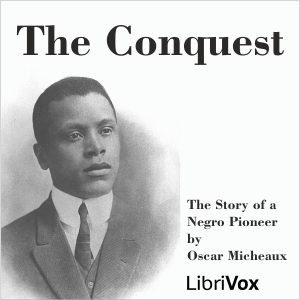
“This is the true story of a negro who was discontented and the circumstances that were the outcome of that discontent.” While considered a novel, this largely autobiographical story is based on the author’s experience as an African-American pioneer in South Dakota. (Summary by MaryAnn)

The Conqueror Worm
Edgar Allan Poe was an American writer, editor, and literary critic. Poe is best known for his poetry and short stories, particularly his tales of mystery and the macabre. He is widely regarded as a central figure of Romanticism in the United States and American literature as a whole, and he was one of the country’s earliest practitioners of the short story. Poe is generally considered the inventor of the detective fiction genre and is further credited with contributing to the emerging genre of science fiction. – Summary by Wikipedia

Bear Creek Collection Volume 2
Breckinridge Elkins is the roughest, toughest, fastest-shootin’, hardest-fightin’ feller in the Bear Creek settlement, and probably in the entire Humbolt Mountains. As he travels further from home, he single-handedly takes on outlaws, settles (and starts) feuds and tries his hand at romancing the girls. He also discovers a lot of strange customs among other folks, such as building houses out of boards and wearing clothes that ain’t buckskins. Set in Arizona during the late 1800’s, this collection of stories is a great rollicking romp through the American frontier as seen through the eyes of one of the most enjoyable characters created in the history of tall tales. (Summary by RK Wilcox)

Children’s Short Works, Vol. 037
Librivox’s Children’s Short Works Collection 037: a collection of 15 short works for children in the public domain read by a variety of Librivox members.