
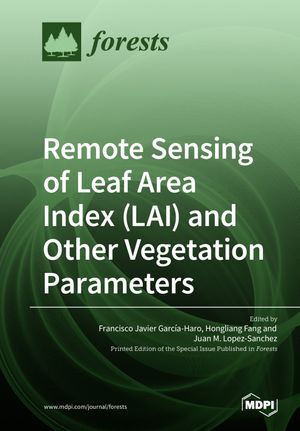
Remote Sensing of Leaf Area Index (LAI) and Other Vegetation Parameters
Monitoring of vegetation structure and functioning is critical to modeling terrestrial ecosystems and energy cycles. In particular, leaf area index (LAI) is an important structural property of vegetation used in many land surface vegetation, climate, and crop production models. Canopy structure (LAI, fCover, plant height, and biomass) and biochemical parameters (leaf pigmentation and water content) directly influence the radiative transfer process of sunlight in vegetation, determining the amount of radiation measured by passive sensors in the visible and infrared portions of the electromagnetic spectrum. Optical remote sensing (RS) methods build relationships exploiting in situ measurements and/or as outputs of physical canopy radiative transfer models. The increased availability of passive (radar and LiDAR) RS data has fostered their use in many applications for the analysis of land surface properties and processes, thanks also to their insensitivity to weather conditions and the capability to exploit rich structural and textural information. Data fusion and multi-sensor integration techniques are pressing topics to fully exploit the information conveyed by both optical and microwave bands.
| Publication Language |
English |
|---|---|
| Publication Access Type |
Freemium |
| Publication Author |
Hongliang Fang |
| Publisher |
MDPI |
| Publication Year |
2023 |
| Publication Type |
eBooks |
| ISBN/ISSN |
9780000000000 |
| Publication Category |
Open Access Books |
Kindly Register and Login to Shri Guru Nanak Dev Digital Library. Only Registered Users can Access the Content of Shri Guru Nanak Dev Digital Library.
You must be logged in to post a review.







Reviews
There are no reviews yet.