Migranti: la sfida dell’integrazione
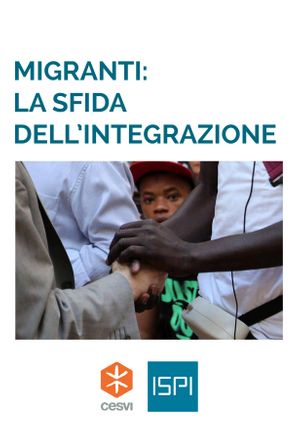
If human mobility is an inalienable right of each individual, it is true that people must not be forced to migrate: work for development in the countries of origin, transit and affected by south-south migration, especially from Africa, by to which a large part of the migration flow comes, it is therefore essential, in order to create conditions that encourage food security, sustainable development and resilience, involving the community, civil society and the private sector, and addressing the complexities linked to changes climate. The right to human mobility is accompanied by the right of each sovereign state to regulate the migratory flows that cross its borders. Finding a sustainable balance between these rights is a challenge for everyone: what is certain, however, is that each country should aspire to “govern” migration processes and not simply suffer them. While the news on landings continues to follow, even if at a slower pace than in the recent past, it is right to stop and reflect. Since last year, landings in Italy have fallen by over 80%, but in the last five years the number of refugees and other beneficiaries of international protection has increased by 180,000, and there are still around 130,000 asylum seekers waiting. In addition, many of the people who see themselves denied a request for asylum cannot be repatriated and will remain in Italy. It is therefore appropriate to ask: is there a distance of integration between the newly arrived and foreigners present in Italy for some time? Is it worth investing in the integration of those who have landed in Italy in recent years? And if so, with what resources? With this joint paper, ISPI and Cesvi want to suggest a way. Which is certainly not the only one, but which opens up new scenarios and new possibilities.
L’Onegin di Giovanni Giudici
The ideal inclusion of Eugene S. PuΕ‘kin’s Eugenio Onieghin in Italian verses in Giovanni Giudici’s work in verse is for us, and for a long time, a fact (I can testify that only external reasons have caused the verses of the life, the “Meridian” which collects his “Collected Poems”, does not contain the “enterprise of words” to which our poet dedicated himself for at least thirty years. In this, after all, beyond the differences of taste of the readers, lies the difference between “our” (I mean generatively) Eugenio Onieghin and the Evgenij Onegin translated by Ettore Lo Gatto: the undisputed belonging of the former to literature in the our language, its correspondence to a “will to say” (just the Dantesque formula) authoral which is of a poetic source. The book by Sara Cerneaz puts us now, vis-Γ -vis its first readers (they also respond to the names of Folena and Contini), in the incomparably privileged condition of those who can attend the visits, in the workshop of the poem, of the one that Giudici called Β«La Lady not sought Β»: the oneΒ« which once had the name of Inspiration Β». Thus begins a new phase in the life of Eugenio Onieghin within our literature. (Rodolfo Zucco)
Limiti e diritto
This work collects some writings of PhD students and new doctorates in Rights and Institutions of the University of Turin, following the common thread of the concepts of “Limits and Law.” The choice of this theme stems from the need to bring together contributions in different legal subjects, which share the public nature, but each with heterogeneous practical variations. In fact, we move from the philosophy of law to administrative law, from the internationalist perspective to criminal law.
Le trappole morali di Primo Levi
In the collections Storie natural, Vizio di forma and LilΓt and other stories, as well as in the stories written in the last years of his life, it is evident the intent of Levi to use myths to give strength to his own narrations: he not only loves playing with traditional myths, it also creates alternative ones, bringing together the Greco-Roman, Jewish and science fiction traditions of which he was an avid reader. Prometheus, the Golem, LilΓt and the centaur: these are the figures that come back in many stories and that for their mythical origin are the gateway to a world of anthropologically meaningful meanings, enriched in the course of various historical elaborations. Thanks to the semiotic density of these symbols Levi can present his ethics in narrative form without running excessive risks of simplification, exploring ambiguity and dilemmas of the human condition. It is time to re-read these tales of invention. They could prove as time-resistant as the Auschwitz protocols.
“Le mani sulla legge”: il lobbying tra free speech e democrazia
“This work deals with lobbying from a legal point of view, and in particular legal-constitutional (comparative): it analyzes that is how this practice, whose impact on the democratic process is very high and constantly growing, is regulated, and above all which both the constitutional framework in which this regulation moves, and what this tells us about the legal system as a whole in some particularly significant systems: USA, Europe (EU and Council of Europe) and Italy “. (From the text)
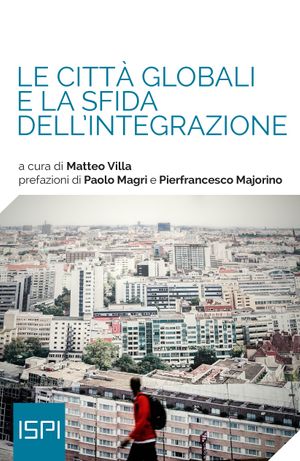
Le cittΓ globali e la sfida dell’integrazione
In the great challenge for integration, European cities are at the forefront. The foreign population in the cities is constantly increasing and today already exceeds 30% in Berlin, Vienna and London. Local administrations therefore play an increasingly important role in managing increasingly complex integration. Integrating foreigners in fact requires the commitment to coordinate policies that regard very different areas: first reception, education, the labor market, health services, combating segregation. This volume deals with the topic of growing urban diversity, trying to answer some crucial questions: what problems do cities face in facing the challenge of integration? How can successful experiences be enhanced? And how can dialogue between cities, regions, national governments and European institutions be improved?
Lβarmonizzazione del diritto europeo: il ruolo delle corti
The participation of prof. Christian von Bar, promoter of the academic study at the base of the Common Frame of Reference Draft, at a meeting organized in Turin on 7 October 2016 was the stimulus that gave life to this work aimed at investigating the role of jurisprudence in interpretation and in the harmonization of European private law. Also for these reasons we are particularly grateful to the Professor for having accepted to write the preface to the volume. The Quaderno is divided into two sections: in the first, entitled The harmonization and standardization of European private law, the theme of the relationship between the EU courts, the national courts and the administrative authorities is dealt with, and that of the contribution that the project of the Draft Common Frame of Reference has given to the process of harmonization of European private law; the second section, instead, is dedicated to the role that the Courts played in the aforementioned harmonization process; In this regard, particular emphasis was placed on the legal comparison and later on the DCFR. This section shows how, in many other European countries, the use of the solutions proposed by the Draft has contributed decisively to the jurisprudential evolution of national private law.
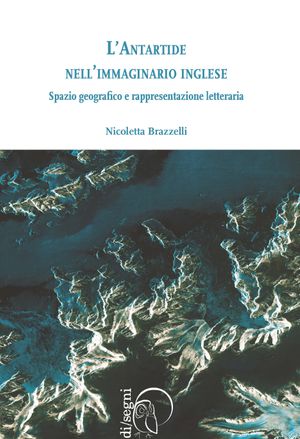
LβAntartide nell’immaginario Inglese
Highlighting the disciplinary contiguities existing between territorial studies and literary studies, the volume examines the representations of Antarctica in a series of narratives in English that constitute a rich repertoire of geographic imagery. The continent of ice has in fact been configured as an empty space that, over time, has coincided with the desire to reach knowledge of the natural world, lending itself to a ‘colonial’ appropriation not so much in a physical and material sense as in terms of verbal and iconographic. In English culture, the space of the extreme South has inspired a multiplicity of stories, from the chronicles of explorers in the early decades of the twentieth century to contemporary female and dystopian narratives. From Captain Scott to Beryl Bainbridge, from Cherry-Garrard to science fiction, an Antarctic ‘psychotopography’ has been created which reflects the charm and mystery of an anomalous place, deeply rooted in the imaginative dimension.
L’accesso al farmaco
“The drug is an asset of legal relevance both as instrumental to the protection of health and as a possible object of economic relations. It is therefore clear that the discipline of drugs is at the crossroads of different interests and how the relationship between this good and its right can be interpreted through multiple perspectives “. (From the text)
La tua vita
It is the passionate novel in which the maternal feeling is debated that sometimes, in its sublimity, unconsciously takes the form of selfishness. Maura, a very young vdova, does not move to a new marriage to concentrate all her affections on the only son, Roberto; but because he is not torn from the love of another woman, from a boy he tries to induce him to the priesthood. By attending the seminary, before taking the minor vows, the young man feels that he does not have a vocation and ends up rejecting the cassock, with great concern of his mother, who has since started a vigilant struggle against the natural tendencies of his son, and it is following this intense exclusive affection that the novel takes place in the most painful situations that end up overwhelming Roberto’s righteousness and Maura’s peace.
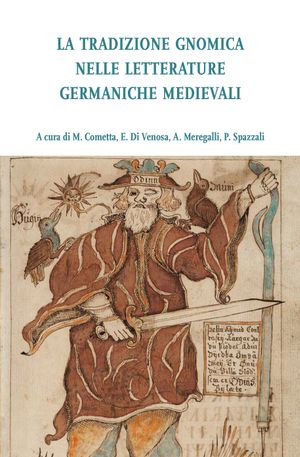
La tradizione gnomica nelle letterature germaniche medievali
The volume contains essays dedicated to the gnomic tradition in medieval Germanic literatures. After a first contribution that illustrates the main strands of phraseological and paremiological research, the discussions deepen the didactic element by addressing linguistic, literary and socio-cultural issues in different textual genres, some oriented to gnomic contents, such as riddles, legal codes, collections of maxims and proverbs, others of epic, elegiac or mystical character. The studies cover areas of English, German, Dutch and Frisian, in the ancient and middle periods, with contacts and references also to the Nordic area. The numerous gnomic microtexts show a great capacity for diffusion and penetration in different cultural contexts, both circulating individually and inserted in wider texts. Styles and contents recur in all European linguistic areas, highlighting the close link between the Germanic world and the classical and biblical-Christian wisdom tradition.
La responsabilitΓ degli Stati e delle organizzazioni internazionali
The volume brings together a series of writings on international responsibility, all aimed at answering a general question: how do the secondary rules of international law behave in the face of a juridical and factual reality that has changed profoundly from that existing at the time of their codification? It is a reality that requires a rethinking of existing international obligations, if not the elaboration of new rules. The existence of new – or renewed – regimes makes it urgent to question the rules of definition, attribution and ascertainment of international responsibility deriving from their violation. The volume is divided into three parts: the first part deals with the reconstruction of international obligations in the most problematic contexts of the current international reality, including the development of new technologies, cyberspace, climate change and large migratory flows; the second part focuses on the subjective element of the offense and looks in particular at the difficulties that emerge in terms of attribution in the context of international crisis management experiences through forms of hybridization between public and private or cooperation between several international subjects; the third and last part examines the consequences of the offense and the questions relating to the ascertainment of responsibility, in order to assess the effectiveness of international standards with respect to offenses of particular gravity or complexity.
La nuova legge elettorale italiana e i dubbi di costituzionalitΓ
The new Italian electoral law (November 2017) is the sixth in the history of the Republic and presents serious reasons for criticism both for the approval procedure and for the dubious constitutionality on the merits. This apart from the lack of suitability to achieve the objective of guaranteeing a solid and non-fragile basis for the governability of the country. The confidence vote, adopted for the approval of the law in the two branches of parliament, is based on a superficial and casual interpretation of the relevant provisions of parliamentary regulations, detached from the spirit of the constitution and its last paragraph of article 72. The political class, which has developed the new law, not only has not learned from the most recent political experiences, but has also neglected the guiding lines of constitutional jurisprudence, reaffirmed in the last two sentences on the subject, n. 1 of 2014 and the n. 35 of 2017 (which the present volume reports in the appendix), which declared the partial unconstitutionality of the electoral laws of December 2005 and May 2015.
La notificazione tra conoscenza legale e conoscenza effettiva
The notification is intended to provoke knowledge, as can be inferred from its very name, deriving from the Latin notum facere. In the institute however – Minoli observed in one of the most important studies on the theme of the last century – the predominant role is played by the facere, by the activities to be carried out, and not by notitia: the effective achievement of knowledge is not essential for the procedure to take place. Over the years this sensitivity has changed. The constitutional protection granted to the right of defense and the influence of other models, in particular the German one, have made it more felt the need for the rules of notification to provide the recipient with a real chance to learn the content of the act addressed to him, so as to determine their behavior in time. This need conflicts with another, which is also of primary importance. If to exercise a right it is necessary to make a deed known to someone, the holder must have a reliable knowledge production tool, able to overcome any obstacles due to the poor cooperation of the recipient. Otherwise, enforcing the right in question would be very burdensome, if not completely impossible. Rules are therefore needed that, in the presence of certain assumptions, require us to consider what is not necessarily so, sanctioning its legal knowledge.
La GrΓ’ce de Montrer son Γme Dans le VΓͺtement: Tomo 3
From the Twentieth Century to Contemporary Contemporary French, Liana Nissim dedicated her intense research activity to the 19th century, in particular to Gustave Flaubert and StΓ©phane MallarmΓ©. His studies also focused on the French-speaking literature of Black Africa and QuΓ©bec, which he helped introduce in Italy and spread on an international scale. This triptych of volumes “La grΓ’ce de montrer son Γ’me dans le vΓͺtement”. Writing about fabrics, clothes and accessories illustrates and deepens in many directions a theme dear to her and widely present in her works. Through the wealth of methodologies and critical perspectives, the scientific community that has shared with her the passion for research and dedication to university life wants to make them a grateful homage.
La GrΓ’ce de Montrer son Γme Dans le VΓͺtement: Tomo 2
The nineteenth century and the Tournant du Siecle Eminent Frenchman, Liana Nissim dedicated her intense research activity to the 19th century, in particular to Gustave Flaubert and StΓ©phane MallarmΓ©. His studies also focused on the French-speaking literature of Black Africa and QuΓ©bec, which he helped introduce in Italy and spread on an international scale. This triptych of volumes “La grΓ’ce de montrer son Γ’me dans le vΓͺtement”. Writing about fabrics, clothes and accessories illustrates and deepens in many directions a theme dear to her and widely present in her works. Through the wealth of methodologies and critical perspectives, the scientific community that has shared with her the passion for research and dedication to university life wants to make them a grateful homage.
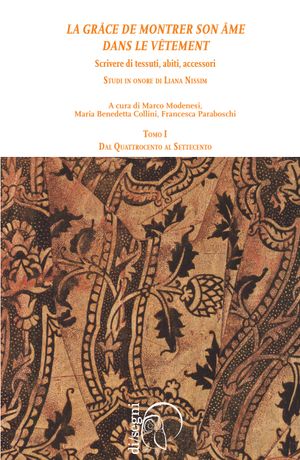
La GrΓ’ce de Montrer son Γme Dans le VΓͺtement: Tomo 1
From the fifteenth to the eighteenth century Eminent Frenchman, Liana Nissim dedicated her intense research activity to the nineteenth century, in particular to Gustave Flaubert and StΓ©phane MallarmΓ©. His studies also focused on the French-speaking literature of Black Africa and QuΓ©bec, which he helped introduce in Italy and spread on an international scale. This triptych of volumes “La grΓ’ce de montrer son Γ’me dans le vΓͺtement”. Writing about fabrics, clothes and accessories illustrates and deepens in many directions a theme dear to her and widely present in her works. Through the wealth of methodologies and critical perspectives, the scientific community that has shared with her the passion for research and dedication to university life wants to make them a grateful homage.
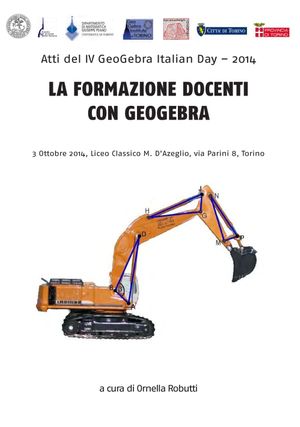
La formazione docenti con Geogebra
The fourth GeoGebra Day organized by the Department of Mathematics and the Institute of GeoGebra of Turin, was held at the high school D’Azeglio in Turin on 3 October 2014. For the first time since the beginning of the Turin GeoGebra Day experts were invited from from the Universities and GeoGebra Institutes of other States (Germany, Spain, France and Australia), making possible an international exchange of ideas, methodologies and good practices for the use of GeoGebra in the classroom, both in mathematics and in physics. The issues addressed in the plenary reports by Italian and foreign experts concerned the modeling, the problem solving, the demonstration and the support that GeoGebra can provide in these activities, the use of tools and materials, the application of laboratory methods both in training of teachers who work in the classroom.
La fonte rimossa
In 1803 Ugo Foscolo published in Milan a commented edition of the Coma Berenices catulliana. It is a work that, more than two hundred years later, continues to be a problematic interpretation in its inspiration, in its meaning, in its aims: the reasons that led the 25-year-old Foscolo to engage in a job for him as well are uncertain. apparently alien in spirit and education. If it were true what was declared in the final Commiato, that is that the author’s sole purpose was to mock the method of “pedants” in commenting on an ancient author, it would not explain the erudition he himself professed nor the seriousness of the final result . The ambiguity actually pervades the whole work, which seems to proceed according to a wavering motion of adhesions and repulsions. This is what we can also say about Foscolo’s judgments on Callimachi elegiarum fragmenta, cum elegia Catulli Callimachea of ββthe great Dutch philologist L.C. Valckenaer (1715-1785), a posthumous work published in Leiden in 1799 by J. Luzac. Although mockingly emphasizing in many places the extreme complexity of the Valckenaerian edition and its aversion to the modus operandi of the scholar Batavo, an exponent of the so-called Schola Hemsterhusiana, Foscolo actually made Callimachi elegiarum fragmenta one of the main sources of his work around the Chioma of Berenice: a tacit but decisive contribution, whose features are identified and examined for the first time in a systematic form.
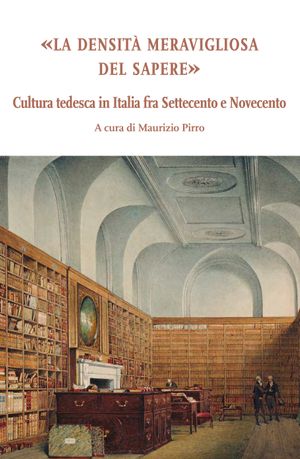
La densitΓ meravigliosa del sapere
The reception of German culture in Italy, starting from the mid-eighteenth century, takes shape within an increasingly ramified network of mediators and mediation structures. Academies, universities, publishing houses and magazines mark the perimeter within which the activity of intellectuals animated by multiple interests unfolds, linked to a transnational conception of their profession and often able to intercept early tendencies and movements still at an initial state, creating the conditions for their incardination into Italian culture. A circulation of ideas that accompanies the development of social and political relations between the two countries, often providing incisive interpretation tools for tensions, conflicts and rapprochements.
La βcultura Xβ Mercato: pop e tradizione
Juan Bonilla, Ray Loriga and Juan Manuel de Prada. The 90s of the 20th century marked a point of no return for society and Spanish letters: full integration with the contemporary brought with it the subjection to the laws of the market and the affirmation of a narrative open to hybridization between languages, intolerant of the distinctions between high culture and popular entertainment. In this volume we try to trace a reasoned balance of this passage, dismantling questionable generational phenomena and bringing together tradition and pop, in a confrontation involving the literary trajectories of Ray Loriga, Juan Bonilla and Juan Manuel de Prada, emblematic for their unfolding between these two extremes in search of a laconic prose like a verse of rock or exuberant song of metaphors, in the sign of a playful or refined metaletteratura, between cinema, music, television and baroque.
La conseguenza di una metamorfosi
In the last thirty years a side of Spanish poetry, identifiable with the generalizing label of ‘poetry of experience’ and represented to the highest degree by the poet Luis GarcΓa Montero, has taken on a civic commitment that is often overshadowed by the simplistic identification between experiential poetic themes and the authors’ empirical biography. In order to deepen the study of the commitment contained in GarcΓa Montero’s verses, the analysis of the poetic topoi to which the granadino recurs and which re-elaborates in all his collections proves to be useful, also recovering the postmodern theories proposed by Habermas and that the poem of the experiencia has made its own thanks also to the magisterium of Juan Carlos RodrΓguez. GarcΓa Montero, in fact, taking up the topoi codified by tradition and reworking them in the light of a necessary historical interpretation of contingency, gives life to a poetic system that endows the reader with a profound awareness of freedom and self-determination. Beginning with the study of recurrent images of the poetic ego, the analysis then moves on to the literary space created by GarcΓa Montero which is rooted in the essence of the first person, extends to the representation of the body and definitively expands to the construction of literary cities . The textual analysis shows that the literary images of tradition are transformed by Montero to suggest the need for reappropriation for contemporary man – if pervaded by the democratic spirit – of a new public space, to be established in poetry when the concrete one fails.
La comunicazione politica cinese rivolta all’estero
Beginning in the late 1990s, Chinese political and intellectual circles are becoming aware of the existence of a clear imbalance between the exceptional results of two decades of economic reforms and the relatively marginal role of the People’s Republic in large international forums. The debate on the need to assume a mentality of “great power (ε€§ ε½ εΏζ daguo xintai)” and to “share global responsibilities (ε ±ζ ε ¨η θ΄£δ»» gongdan quanti zeren)”, which arose in those years, is echoed in President Xi’s recent statements Jinping, who warned in January 2014: “To strengthen the cultural soft power of the Nation, it is necessary to increase international discursive power, strengthen competences in international communication, meticulously build a discursive system aimed at foreign countries, make better use of new media and increase the creativity, the appeal and the credibility of the discourse addressed abroad (…). “The volume aims to analyze this evolution of Chinese political communication directed abroad, under different perspectives, in order to reconstruct the essential lines of the conceptual framework, institutional, media and discursive within which the political message is packaged and distributed to the foreign audience.
La Casa di tutti nellβItalia Giolittiana
The experience of the municipalization of social housing in Giolittian Italy makes it possible to focus the extremes of a parable that led to the recognition of housing problems as a matter of collective interest. The genesis of social housing is therefore dispersed in the complex of initiatives that it has been possible to reconstruct in support of an extraordinary corpus of archival documents, investigated in the aegis of the legislative provisions in the matter of public housing and municipalization launched during 1903, real term watershed for the developments of this story. On the background of the combined result arising from the two regulations, in fact, the red thread of the entire narrative unfolds, a journey that moves through fragments of local experiences, micro-historical reflections aggregated in an articulated mosaic based on the adhesive of the municipalization, showing the prelude of a rupture phase capable of liberating the beginnings of today’s welfare state.
Job Crafting: Diventare artigiani del proprio lavoro
This report analyzes the results of the annual research project on Job Crafting conducted by the Bicocca Training & Development Center (BTDC) of the University of Milan Bicocca in collaboration with the associated companies. The aim of the project is to provide an in-depth description of the Job Crafting, of the conditions that favor it and the consequences it generates according to a triple perspective: individual, organizational, of HR policies and practices. In addition, it offers practical and operational insights into how Job Crafting can be promoted using training and development.
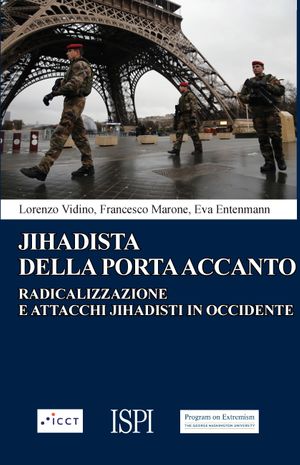
Jihadista della porta accanto
In the last three years, Europe and North America have been hit by an unprecedented wave of terrorist attacks, carried out by individuals inspired by jihadist ideology. Who are the authors of these attacks? Are they born and raised in the West or are they refugees and migrants? How are they radicalized? Were they well educated and integrated or, on the contrary, lived on the margins of society? Have they acted alone? What were their connections with the Islamic State? Answering these and other questions is useful for understanding the nature and scope of the threat and for being able to identify adequate political solutions based on empirical evidence. The study – the first of this type – aims to analyze the demographic profile, the trajectories of radicalization and the links with the Islamic State of the individuals who carried out jihadist attacks in Europe and North America from the proclamation of the so-called Caliphate in June 2014.
Il welfare e il suo doppio
Much of the Camorra’s literary production focuses on the aspects of military control of the territory and on predatory activities in politics and the economy. Less attention is paid to the social reproduction factors of organized crime groups. The aspects of mutuality and internal solidarity in the champs have never received a systematic and in-depth observation. This research instead proposes the analysis of the elements of legitimation and consent of the Camorra groups in the territories in which they are located. The welfare and its double is a work that is articulated through a rich system that uses quantitative and ethnographic methods: an approach located at the meeting point between sociology and anthropology in the analysis of social policies, which uses unpublished and difficult judicial documents availability. A demanding fieldwork in the Caserta area has in fact made it possible to decipher the forms of social assistance present: public and mafia ones. What emerges is the panorama of a criminal whole that ensures an incredible protection against affiliates and their families, which competes with the protections offered by public welfare. However, the results of this study show that it is precisely in the territories most affected by the mafia presence that new forms of social struggle are born. It is here, in fact – where criminal infiltrations affect welfare service contracts – that the most innovative social actions were born in defense of the weakest categories.
Il Socialismo Democratico Italiano fra la Liberazione e la Legge Truffa
Why did republican Italy not have a social democratic party comparable to those of other European countries? And what was Italian social democracy? What political culture did you express? Who were the carriers? These and other questions he tries to answer this book by analyzing the origins of the Italian Social Democratic Party and its history in the early Republican period (1947β1953). Moving on the double track of political history and the history of political cultures, it reconstructs both the convulsive vicissitudes of the socialist area to the right of the PSI and the evolution of the doctrinal horizons, of the interpretative structures of reality and of the ways of understanding political action that this area expressed, focusing attention on the multiplicity of actors, sensitivities and mentalities that met in it for a brief period. In the background are the cold war and the brutal impact it had on the Italian political system.
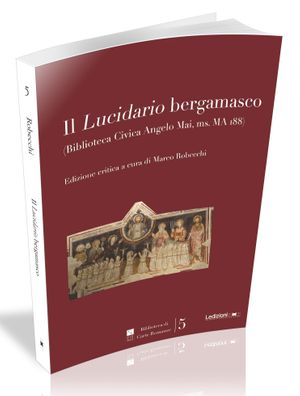
Il Lucidario Bergamasco
Composed at the turn of the eleventh century, the Elucidarium of Honorius Augustodunense enjoyed an enormous fortune throughout the Middle Ages. The manuscripts of the Latin original are hundreds, and the number of versions in various European languages ββis equally exceptional. In Italy there is a translation from the French, preserved by some thirty codes, and three translations from the Latin, one from Milan, one from Bologna and one from Bergamo. Of this last, handed down from a single manuscript of the mid-fifteenth century, the critical edition is offered here for the first time. The study that accompanies it reconstructs its genesis within the environment of the lay brotherhoods that in the fifteenth-century Bergamo collaborated closely with the mendicant orders. In the interest that follows on the historical documentary level, the linguistic one is combined, since it is an important witness of the vernacular employed in the orobic town, open to the uses of the Padra municipal scriptae but still not very permeable to the influence of the Tuscan in the process of affirmation.