

Facts and Fancies
A group of poems about life centered around a southbound train ride to Cincinnati. ( Lynda Marie Neilson)

Facing the Flag
Like The Begum’s Millions, which Verne published in 1879, it has the theme of France and the entire world threatened by a super-weapon (what would now be called a weapon of mass destruction) with the threat finally overcome through the force of French patriotism. (Summary by Wikipedia)

Faces in the Fire, and Other Fancies
In this collection of essays, Frank Boreham shares with us his musings on how everyday items such as boots and linoleum, or a cozy fire, or even Nothing at all, can enrich our spiritual lives and draw us closer to our Heavenly Father. Summary by Devorah Allen.

Faces and Places
Faces and Places is a collection of articles on nineteenth century travel, events and personalities by the British journalist Henry Lucy, who wrote for the Daily News, a London newspaper. His open letter To Those About to Become Journalists rings as true today as when it was written. The first article, “Fred” Burnaby, includes a lively account of a balloon trip, while Night and Day on the Cars in Canada and Easter on Les Avants relate Lucy’s experiences of rail travel at that time. Other travel tales (A Night on a Mountain, Mosquitoes and Monaco, and Oysters and Arcachon) provide an insight into the Victorian Englishman’s attitude to Europe. Three of the pieces, With Peggotty and Ham, A Cinque Port and Christmas Eve at Watts’s, concern the county of Kent, where Lucy had a country house. Christmas Eve at Watts’s contains an interesting expos? of Dickens’ short story The Seven Poor Travellers. Other articles are of historical interest: A Wreck in the North Sea is an account of the wreck of the ship “Deutschland” in 1875; A Historic Crowd describes the massive popular interest in the 1871 trial of the Tichborne Claimant; The Battle of Merthyr contains an eye-witness account of the Merthyr Riots of 1831; The Prince of Wales paints a portrait of the future King Edward VII. Lucy, who also wrote as “Toby, M.P.” for the satirical magazine Punch, loved to poke gentle fun, particularly at the establishment, and this is especially evident in A Peep at an Old House of Commons and Some Preachers I Have Known. This eclectic collection, mostly affectionately humorous, but with moments of great pathos, was originally published in 1892 in The Whitefriars Library of Wit & Humour.(Summary by Ruth Golding)

The Face on the Barroom Floor
LibriVox volunteers bring you 8 different recordings of The Face on the Barroom Floor by Hugh Antoine D’Arcy.
The Fables of Pilpay
These moralistic stories within stories date back to the Sanskrit text Panchatantra (200 BC ? 300 AD). They were first translated into Arabic by a Persian named Ruzbeh who named it Book of Kalilah and Dimna and then by Abdullah Ibn al-Muqaffa and later Joseph Harris in 1679 and then remodeled in 1818. Max Mueller noted that La Fontaine was indebted to the work and other scholars have noted that Jeanne-Marie LePrince de Beaumont and John Fletcher were both familiar with the fables. The Fables of Pilpay are a series of inter-woven fables, many of which deploy metaphors of anthropomorphized animals with human virtues and vices. (Summary by The introduction and Wikipedia)
The Fables of Phaedrus
The fable is a small narrative, in prose or verse, which has as its main characteristic the aim of conveying a moral lesson (the “moral”), implicitly or, more normally, explicitly expressed. Even though the modern concept of fable is that it should have animals or inanimate objects as characters – an idea supported by the works of famous fabulists such as Aesop and La Fontaine – Phaedrus, the most important Latin fabulist, is innovative in his writing. Although many of his fables do depict animals or objects assuming speech, he also has many short stories about men, writing narratives that seem to the modern eye more like short tales than fables. Despite many other fables being attributed to Phaedrus, only five books are considered by scholarship to have been written by him. Phaedrus’ five books of fables are here presented in a translation to English prose by Henry Thomas Ridley. (Summary by Leni)

The Fables of La Fontaine
Jean de la Fontaine’s fables were very well-known all over Europe during his life, and are now slowly being rediscovered. This edition contains 240 fables or fairy tales and a biography of Jean de la Fontaine and Aesop, containing the most well-known fables in existence, as well as some lesser-known fables and stories. Walter Thornbury’s translation furthermore sets the fables into memorable rhymes. – Summary by Carolin
Fables of Aesop and Others
The origins of these fables are perhaps lost in obscurity, but they are so closely identified with the Greek writer Aesop, that we may regard them as such. Most of these tales involve interactions among animals, and to each is appended a moral. This edition was edited and illustrated by Thomas Bewick a well-known British engraver and illustrator. The book begins with an excellent introduction – Larry Wilson
Fables in Slang
While a columnist for The Chicago Record humorist George Ade penned numerous ?fables? which were subsequently collected into books. Fables in Slang is the first of these collections. It contains 26 satirical stories that lampoon phrenologists, idealists, snobs, fanatics and other ignorant fools of the day, most of which still wander through our modern lives. Jean Shepherd considered Ade a predecessor who made writers like James Thurber, Mike Royko, and himself possible. Fables in Slang was first published in 1899 by Herbert S. Stone and Company. (Summary by Gregg Margarite)
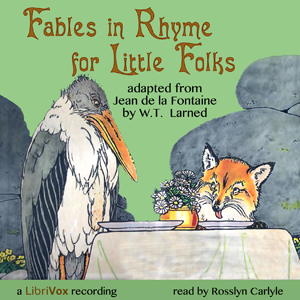
Fables in Rhyme for Little Folks (version 2)
This is a short book which collects together 18 charming fables, written in rhyme and intended to be enjoyed by children. Based on stories which were originally written in French by Jean de la Fontaine, these quirky fables are sure to entertain people of all ages. – Summary by Rosslyn Carlyle
Fables in Rhyme for Little Folks
Several of La Fontaine’s fables, translated into English by W. T. Larned. (Summary by bge1234)
Fables for the Frivolous (Version 2)
Fables for the Frivolous is one of the earliest works by the American parodist Guy Wetmore Carryl. These fables are adapted from Jean de La Fontaine’s original writings. The Aesop-style fables are written in verse, and are light-hearted re-tellings of fables from two centuries before, each ending with a moral and a pun. Among the more celebrated of the fables are The Persevering Tortoise and the Pretentious Hare, The Arrogant Frog and the Superior Bull, and The Sycophantic Fox and the Gullible Raven. (from Wikipedia)
Fables for the Frivolous
One of the earliest works by the American parodist, Guy Wetmore Carryl, these fables are adapted from Jean de La Fontaine?s original writings. The fables are written in verse, and are light-hearted re-tellings of fables from two centuries before, each ending with a moral and a pun. Among the more celebrated of the fables are The Persevering Tortoise and the Pretentious Hare, The Arrogant Frog and the Superior Bull, and The Sycophantic Fox and the Gullible Raven. (Summary written by Chriss)

Humour of the North
Some day an enterprising editor may find time to glean from the whole field of Canadian literature a representative collection of wit and humour. . . . The present little collection obviously makes no such ambitious claim. It embraces, however, what are believed to be representative examples of the work of some of our better-known writers, many of which will no doubt be quite familiar to Canadian readers, but perhaps none the less welcome on that account. (Summary from the Introduction)

The Fable of the Bees
Bernard Mandeville’s didactic poem praising the virtues that personal vices bestow on society as a whole, along with several treatises and dialogues explaining and defending it. Mandeville’s theories were influential in the development of both the moral philosophy of the Scottish Enlightenment and the methodology of modern economics. – Summary by Matthew Mu?oz
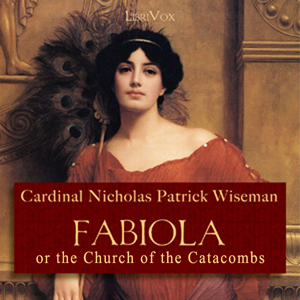
Fabiola or The Church of the Catacombs
This historical novel is set in Rome in the early 4th century AD, during the time of the cruel persecution of Christians under the Emperor Diocletian. The heroine of the book is Fabiola, a young pagan beauty from a noble Roman family. Fabiola seems to have everything, including a superior education in the philosophers, yet under the surface, she is not content with her life. One day, in a fit of rage, she attacks and wounds her slave girl Syra, who is a secret Christian. The proud, spoiled Roman girl is humbled by Syra’s humility, maturity and devotion to her in this situation, and a slow transformation begins. Woven into this fictitious story are a number of martyrdom accounts of real-life Christian saints, including Saint Agnes, Saint Tarcisius and Saint Sebastian. Cardinal Wiseman wrote Fabiola in part as an answer to the vigorously anti-Catholic book Hypatia by Charles Kingsley. The novel was mainly aimed at the embattled Catholic minority in England, who had recently emerged from a half-illegal status. (Summary adapted from Wikipedia)

The Eyes Of The World
The Eyes of the World was the Best Selling Book for 1914 according to Publisher’s Weekly. The novel explores what Harold Bell Wright views as the false world of artists, writers, critics, and their wealthy patrons. Two of the main characters are the famous author, Conrad LaGrange and Aaron King, an aspiring artist. LaGrange regretfully describes his writings as ?filthy stories in good English? and feels he has sold his soul to become successful. While in California, recovering from a physical breakdown, he befriends Aaron King whose mother he knew when he was a boy. Lagrange serves as counselor to the young man, for he knows the pitfalls of success from his own experience. (Summary by Tom Weiss)
The Eyes of the Movie
“The movie was born in the laboratory and reared in the counting-house. It is a benevolent monster of four I’s: Inventor, Investor, Impresario, Imperialist.” So begins Harry Alan Potamkin’s The Eyes of the Movie, a posthumously published indictment of Hollywood. It is a savage socialist critique of the film industry, its practices, and products. Potamkin takes aim at the “conservative element” infiltrating Hollywood’s dream factory, investigating mainstream cinema’s double function as propaganda and “passing amusement.” (Summary by ChuckW)
Eyes Like the Sea
He was a painter, a poet, a novelist. He lived during the Hungarian revolution and his love of freedom meant his life was often in peril. She was his first love, this girl with the eyes like the sea. She was at heart noble, good and loving. What an excellent lady might have been made out of this woman, if she had only met with a husband who, in the most ordinary acceptance of the word, had been a good fellow, as is really the case with about nine men out of every ten. But she always managed to draw the unlucky tenth out of the urn of destiny. And so she spurned his true love in favor of a high-flying dandy. He went on to pursue a life of politics and she to follow her capricious heart. But yet, throughout her life, she kept returning to him and to the end, of all men, she loved him perhaps best of all. (Eyes Like the Sea won the Hungarian Academy of Sciences prize for literature in 1890.) (Summary by MaryAnn)
The Eyes Have It & Tony and the Beetles
Aliens have invaded the earth! Horrible one celled creatures disguised as normal human beings ! Well, at least that is what it seems to the author. Yes, The Eyes Have It is a whimsical story, making gentle fun of certain writing styles, but only a topflight science-fictionist like Philip Dick , we thought, could have written this story, in just this way. Tony and the Beetles takes place far in the future when Earth’s enormous colonial empire is well established but the question is, how long can it last? 10 year old Tony grows up fast when history catches up with the human race. A sobering look at human history .. and our probable future. Two very different stories but both entertaining. (Summary by the magazine editor and Phil Chenevert)
Eyebright
“Imagination is like a sail, as Mr. Joyce had said that evening; but sails are good and useful things sometimes, and carry their owners over deep waters and dark waves, which else might dampen, and drench, and drown.” Twelve year old Isabella Bright is endowed with just such an imagination and spends her time amusing herself and her friends with stories. Will her imagination be called upon to help her navigate tempestuous seas? – Summary by Lynne Thompson
The Eye of Osiris
The Eye of Osiris is an early example from the Dr. Thorndyke series of detective stories written by R. Austin Freeman. In these stories, the author drew on his extensive medical and scientific knowledge for his main character, a medico-legal expert who relies on forensic evidence and logical deduction in solving cases. In this case, Thorndyke steps in to investigate the disappearance of one John Bellingham, an English gentleman and amateur Egyptologist, who has vanished under very mysterious circumstances. Thorndyke’s involvement in the case arises from a both purely professional interest in the unique character of the case, as well as from the fact that a young doctor and former student of his has recently become closely acquainted with the missing man’s brother and niece. (summary by J.M. Smallheer)
The Eye of Dread
The Civil War is upon the United States, and the town of Leauvite has sent away its young men, among them Peter Junior and Richard Kildene. When they leave, Betty Ballard is but a child, but by the time the war has ended, she has become something else entirely. Wounded, Peter Junior finds his time at Betty’s father’s studio, learning to become an artist, until one day he proposes to her after deciding to go to France. Of course, she agrees to wait for him. Meanwhile, Richard, who has decided to work on the railways, expects that when he gets back, that Betty will be waiting for him. With these complications, problems begin to arise… (Summary by Chelsea)
An Eye for an Eye
A short but typical Trollope romance in which a young nobleman is torn between love for an impoverished Irish girl and the expectations of his family that he will marry someone suitable for inheriting an Earldom – Summary by Anthony Ogus
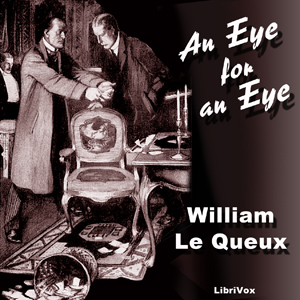
An Eye For An Eye
Frank Urwin and Richard Cleugh are two bachelor journalists sharing a flat in London. One evening while chatting, Urwin receives a telegram from a police acquaintance to come to the local police station at once. Urwin visits Inspector Patterson who is greatly agitated. Patterson invites Urwin for a drink and tells him of a strange occurrence at a local house. The two visit the house where they discover a dead young male and attractive young female. For some reason, Patterson is reluctant to report the apparent murders. While at the house, the telephone rings and Urwin answers it. A strange voice asks if the deed has been done? Urwin indicates it has and agrees to meet the caller at St. James?s Park. Urwin finally convinces Patterson to report the crime and a second visit occurs with additional police. This time however, the dead female is not the same person. (Summary by Tom Weiss)

Short Story Collection Vol. 045
LibriVox?s Short Story Collection 045: a collection of 20 short works of fiction in the public domain read by a group of LibriVox members.
The Extraordinary Adventures of Ars?ne Lupin, Gentleman-Burglar (version 3)
A series of loosely related short stories of the early adventures of France’s famous gentleman burglar, Ars?ne Lupin, as told by an admirer and trusted friend. (Cate Barrat)
The Extraordinary Adventures of Ars?ne Lupin, Gentleman-Burglar (version 2)
This collection of independent stories first published between 1905 and 1907 in the magazine Je Sais Tout recounts the tales of Ars?ne Lupin, the famous gentleman-burglar: the first story marks the introduction of the character to the public, and its success encouraged author Maurice Leblanc to write several others, collected and published as a book in 1907. Ars?ne Lupin would go on to be the main character in several short stories and novels, written by Leblanc and others, and whose legacy would appear also in comics, movies and video games, becoming the icon of the affable and charming man who, choosing to walk on the wrong side of law, still can be a force for good. – Summary by Leni
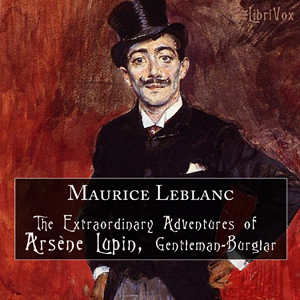
The Extraordinary Adventures of Ars?ne Lupin, Gentleman-Burglar
A contemporary of Arthur Conan Doyle, Maurice Leblanc (1864-1941) was the creator of the character of gentleman thief Ars?ne Lupin who, in France, has enjoyed a popularity as long-lasting and considerable as Sherlock Holmes in the English-speaking world. This is the delightful first of twenty volumes in the Ars?ne Lupin series written by Leblanc himself. In an unprecedented act of literary pastiche and cross-over, Sherlock Holmes and Lupin actually meet, briefly in this first volume, and more substantially in the next. But after legal objections from Conan Doyle, the name was changed to “Herlock Sholmes.” (adapted from Wikipedia by a.r.dobbs)